Understanding Internal Resistance in Lithium-Ion Cells
When comparing lithium-ion cells, capacity and discharge current usually get the most attention. But internal resistance is just as important, especially in high-power applications such as drones, power tools, robotics and electric vehicles.
Internal resistance determines how much voltage is lost and how much heat is generated when current flows through a cell.
A simple relationship is:
Voltage Drop = Current × Internal Resistance
Heat generation follows:
Power Loss = I²R
Because current is squared, even a small increase in resistance can create significantly more heat at high discharge rates.
For example, at 100 A, a battery with 10 mΩ resistance produces around 100 W of resistive heat. At 20 mΩ, that increases to 200 W.
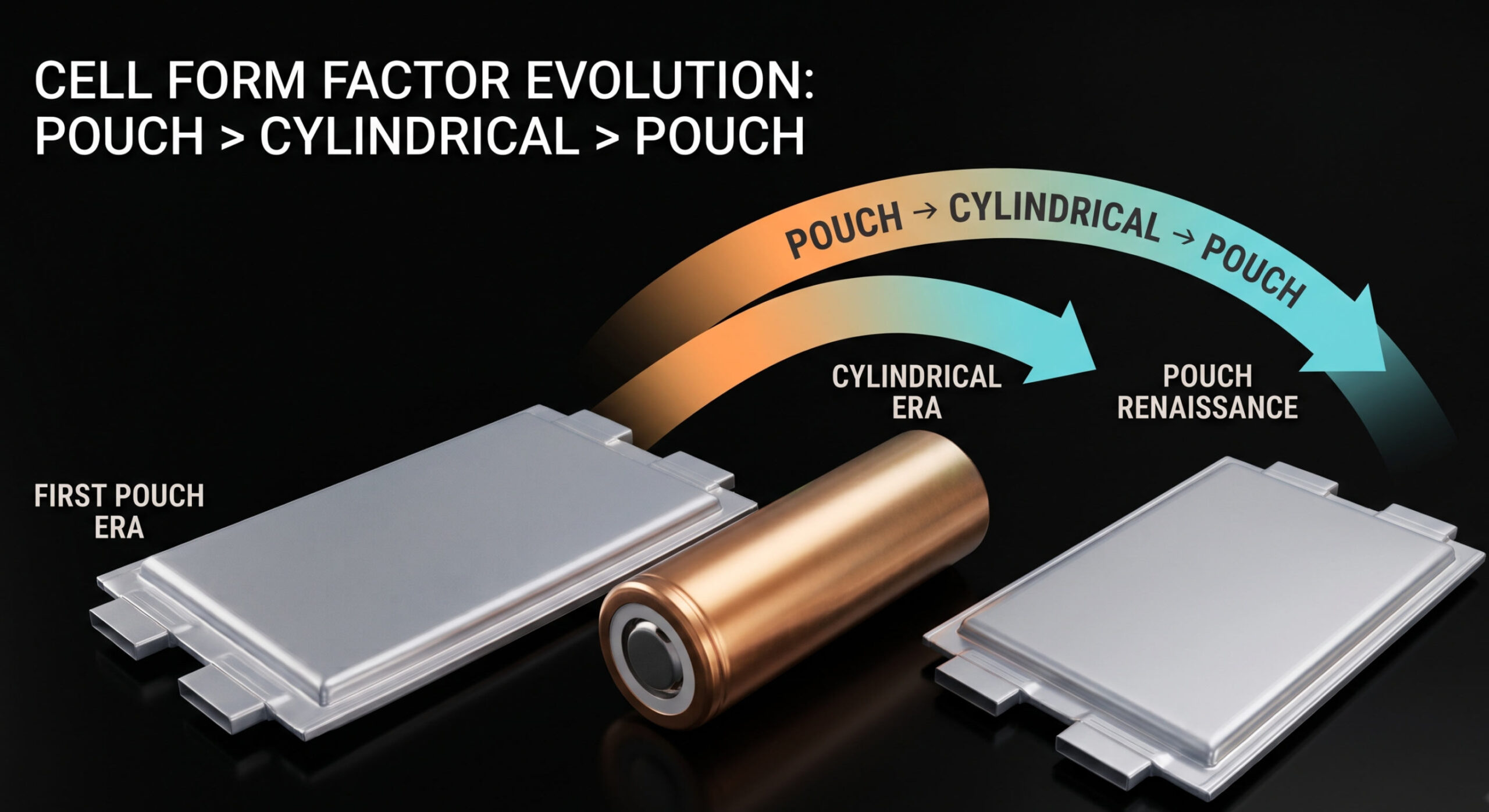
Pouch Cells
Pouch cells use stacked or folded electrodes inside a flexible aluminium-laminate package.
Their wide electrode tabs can provide relatively short current paths, making pouch cells capable of very high discharge rates when designed for power.
They also offer good packaging efficiency and low weight.
However, pouch cells require mechanical support and must accommodate swelling during operation.
Conventional Cylindrical Cells
Cylindrical cells such as 18650 and 21700 typically use long electrode sheets wound into a jelly roll.
In conventional designs, current must travel through the aluminium or copper current collector before reaching one or more tabs.
Electrode ───────────────────── TAB
          → → → → → → → → → →
The longer this current path, the greater its contribution to resistance.
Multi-tab designs improve performance by adding more current collection points.
Tabless Cylindrical Cells
Tabless, or full-tab, cylindrical cells take this concept further.
Instead of collecting current through several narrow tabs, a much larger portion of the electrode edge connects to the terminal.
Traditional
───────────────│ TAB

Tabless
████████████████
↓↓↓↓↓↓↓↓↓↓↓↓↓↓↓↓
Continuous connection
This shortens the current path and distributes current more evenly.
The benefits can include:
- lower internal resistance
- less voltage sag
- reduced heat generation
- higher discharge capability
- more uniform temperature
- better efficiency
Which Cell Has the Lowest Resistance?
There is no universal winner.
A high-power pouch cell may have lower resistance than an energy-focused cylindrical cell, while a tabless cylindrical cell may outperform both in very high-current applications.
Resistance also depends on:
- chemistry
- electrode thickness
- temperature
- state of charge
- cell age
- electrolyte design
- measurement method
Why It Matters
For applications such as drones, internal resistance directly affects how much usable power reaches the motors.
A cell may have excellent capacity, but if resistance is too high, voltage drops under load and valuable energy becomes heat.
This is why battery selection should not focus only on how much energy a cell stores, but also on how efficiently it can deliver that energy when high power is required.
Compare cells for your drone or battery pack
Compare resistance figures only when measurement method, temperature and operating conditions are comparable. Review the complete datasheet alongside current demand, cooling and pack protection.
Start with the Baynor cell catalogue, or review the B65U 6500mAh 60A cell. For a datasheet or quotation, send your model, quantity and application.