Battery technology rarely moves in a straight line.
Over the past decade, lithium-ion battery manufacturers and system designers have continuously shifted between different cell formats in search of the best balance between energy density, power, safety, cost and manufacturability.
For lightweight applications such as drones and UAVs, pouch cells were once the obvious choice. Then improvements in cylindrical cells—particularly 18650 and 21700 formats—changed the equation.
Cylindrical cells became increasingly attractive because of their manufacturing consistency, structural strength, thermal characteristics and rapidly improving energy density.
Today, however, the market is changing again.
Advances in electrode materials, silicon-based anodes, electrolyte systems and semi-solid battery technologies are pushing pouch-cell performance significantly further. For weight-sensitive applications such as UAVs, this is making engineers reconsider the role of pouch cells.
The market is not simply moving from pouch to cylindrical and then returning to pouch.
Instead, battery selection is becoming increasingly application-specific.
And UAVs are one of the clearest examples.
Why Pouch Cells Became Popular
Pouch lithium batteries have been widely used in RC aircraft, FPV drones and commercial UAV platforms for years.
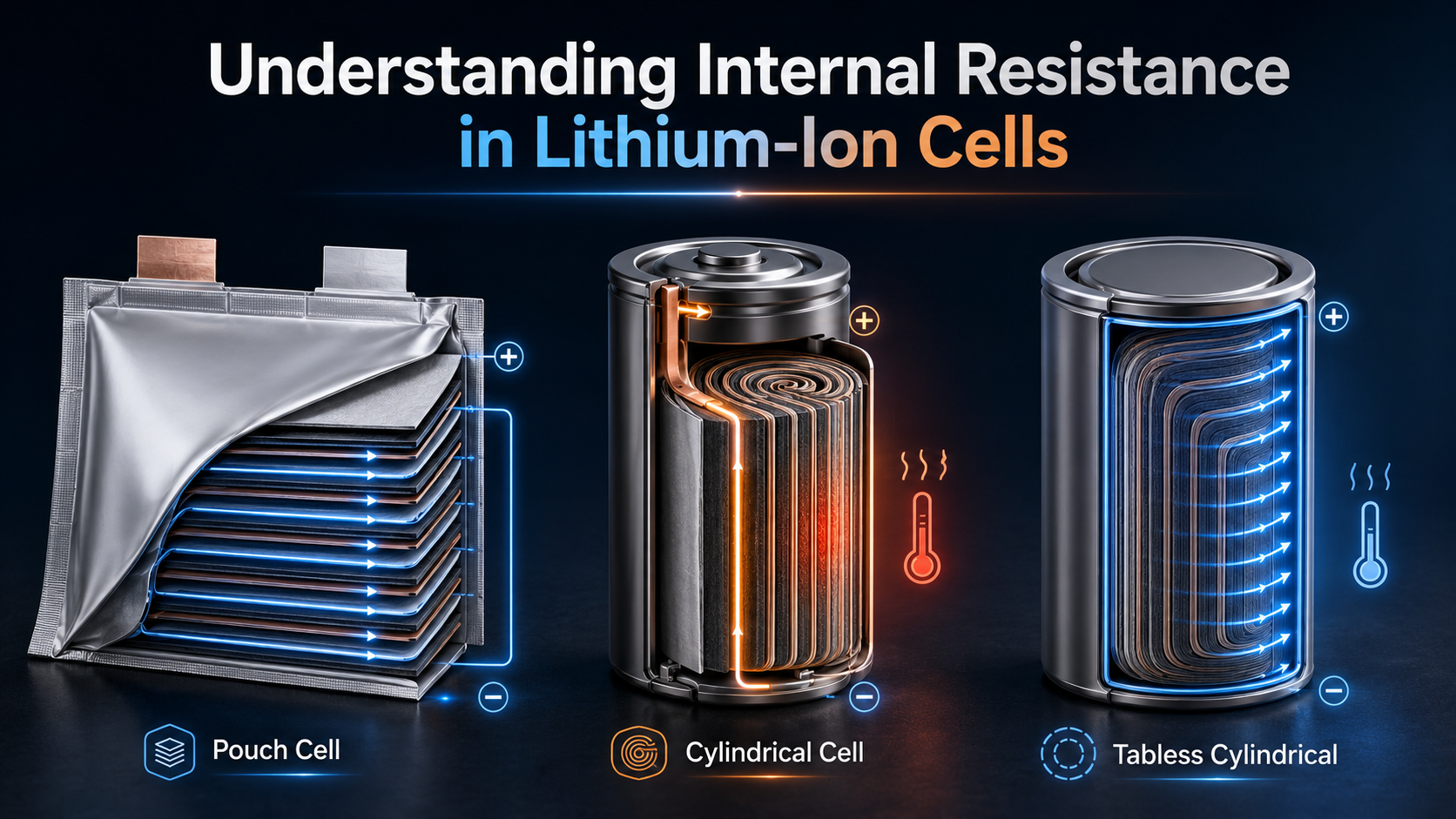
Unlike cylindrical cells, which place the battery materials inside a rigid metal can, pouch cells use a lightweight laminated enclosure.
This reduces the amount of packaging material surrounding the active battery materials.
Their rectangular shape also allows cells to be packed efficiently with very little unused space between them.
Cylindrical cells naturally create gaps when arranged together. These spaces can help with cooling and pack structure, but from a purely volumetric perspective, they do not store energy.
Pouch cells can be stacked much more efficiently.
For an aircraft, where every gram and every cubic centimetre matters, this can be a significant advantage.
Pouch cells can also offer large capacities in a single cell. Instead of connecting many smaller cells in parallel, battery designers may achieve the required pack capacity using fewer individual cells.
This can reduce:
- electrical connections,
- busbars and welding points,
- supporting structure,
- interconnection weight,
- and overall pack complexity.
These characteristics helped make high-discharge LiPo batteries a standard solution in the drone industry.
But pouch cells also have limitations, particularly in mechanical protection, swelling management and manufacturing consistency.
Those limitations created an opportunity for cylindrical batteries.
Why Cylindrical Cells Gained Ground
The development of the electric vehicle industry accelerated investment in cylindrical lithium-ion cells.
Large-scale manufacturing drove improvements in quality, consistency, energy density and cost.
The 18650 format became highly mature, followed by the larger 21700 format, which allowed manufacturers to store more energy per cell while maintaining standardized dimensions and automated production.
As cylindrical-cell performance improved, battery manufacturers began introducing them into applications traditionally dominated by pouch batteries—including UAVs.
There were several reasons.
Mechanical Strength
Each cylindrical cell has its own metal enclosure.
This gives the cell strong mechanical protection against vibration, impact and deformation.
UAV battery packs are often exposed to vibration, repeated takeoffs and landings, and demanding operating environments. Cylindrical cells therefore offer a robust starting point for pack design.
Manufacturing Consistency
Modern cylindrical cells are produced using highly automated manufacturing lines.
Capacity, internal resistance and electrical performance can be tightly controlled across large production volumes.
This consistency is valuable when dozens—or hundreds—of cells must operate together inside one battery pack.
Modularity
Cylindrical cells also make pack design highly modular.
A manufacturer can use the same 21700 cell across many different configurations by changing the number of cells connected in series and parallel.
This makes cylindrical cells attractive for standardized battery-pack production.
Improving Energy Density
Perhaps most importantly, high-energy cylindrical cells became increasingly competitive with pouch batteries in terms of energy density.
For long-endurance UAVs with moderate discharge requirements, lithium-ion cylindrical packs became an attractive alternative to traditional high-power LiPo batteries.
This created a general split in the UAV market.
High-power applications often remained with LiPo pouch batteries.
Long-endurance applications increasingly adopted high-energy cylindrical lithium-ion cells.
But battery technology continued evolving.
The UAV Battery Trade-Off
Every UAV battery designer faces essentially the same challenge.
They want more energy.
They want more power.
And they want less weight.
Achieving all three simultaneously is difficult.
A cell optimized heavily for energy density may not deliver enough current during takeoff or rapid acceleration.
A high-power cell may provide excellent discharge performance but contain less energy per kilogram.
Increasing battery capacity also increases battery weight, which means the aircraft must use additional energy simply to carry the larger battery.
This is why gravimetric energy density, measured in Wh/kg, is particularly important for UAVs.
In an electric vehicle, an additional kilogram of battery creates a relatively small penalty.
In a multicopter, that kilogram must be continuously kept in the air.
Every gram matters.
This creates a strong incentive to remove anything in the battery system that does not directly contribute to storing energy or safely delivering power.
And this is one reason advanced pouch cells are attracting attention again.
Why Pouch Cells Are Becoming Interesting Again
The pouch format itself is not new.
What has changed is the chemistry inside it.
Improvements in cathode materials, silicon-containing anodes, electrolyte systems and semi-solid technologies are increasing the amount of energy that can be stored for a given cell weight.
When a pouch cell achieves high energy density while maintaining strong discharge capability, several advantages begin to combine.
The lightweight pouch enclosure reduces packaging weight.
The rectangular format improves space utilization.
Large individual cell capacities can reduce the number of parallel cells required.
Fewer cells can also mean fewer electrical connections, welds and supporting structures.
This shifts the discussion away from simply comparing individual cells.
What matters more is pack-level energy density.
A cylindrical cell may have excellent cell-level performance, but a complete battery pack still requires cell holders, interconnections, insulation, structural support and busbars.
All of these components add weight.
A large-format pouch architecture can potentially reduce some of this supporting mass.
For UAV designers chasing additional flight time, even relatively small improvements in complete-pack weight can become valuable.
Why Cylindrical Cells Are Not Going Away
The renewed interest in pouch technology does not mean cylindrical cells are becoming obsolete.
Far from it.
Cylindrical batteries continue to offer important advantages.
They have a mature global manufacturing ecosystem, strong mechanical protection, standardized dimensions and well-understood thermal behaviour.
Pack manufacturing can also be highly automated.
Large investments continue to be made in cylindrical formats including 21700 and larger 46-series cells.
For many applications, cylindrical cells remain the better engineering choice.
The change is that new pouch technologies are becoming competitive in areas where cylindrical cells previously appeared to have a growing advantage.
UAV battery design is therefore becoming less about choosing a universally superior format and more about choosing the best architecture for a specific mission.
The Challenges of Advanced Pouch Cells
Higher energy density also creates new engineering requirements.
Pouch cells do not have the rigid metal enclosure found on cylindrical cells, meaning mechanical protection must be incorporated into the battery-pack design.
Pouch cells can also expand or change thickness during cycling and ageing, requiring proper compression and structural management.
Large-format cells need carefully designed thermal systems to maintain uniform temperatures during high-current operation.
Connections between high-capacity cells must also be engineered correctly.
A cell capable of delivering very high current requires appropriately designed tabs, terminals and busbars.
For UAV applications, the complete battery system must also be tested against vibration, rapid load changes, temperature variation and demanding charge-discharge profiles.
High cell-level energy density alone does not guarantee a successful UAV battery.
The complete system matters.
Why UAVs Are a Natural Market for High-Energy Pouch Cells
UAV battery economics are different from those of electric vehicles.
EV manufacturers must optimize for cost, mass production, crash protection, cycle life and large-scale manufacturing.
UAV manufacturers are often willing to pay more for battery technology if it creates a meaningful improvement in aircraft performance.
A lighter battery can increase flight duration.
Higher energy density can allow greater mission range.
Higher available power can support heavier payloads.
For mapping and inspection drones, longer endurance can increase the amount of work completed during each flight.
For fixed-wing UAVs, higher specific energy can directly increase mission range.
For heavy-lift multicopters, the challenge becomes even more demanding because the battery must provide both high energy and high power.
A very high-energy cell that cannot deliver sufficient current during takeoff is not useful.
Likewise, an extremely high-power cell with low energy density may significantly reduce flight duration.
The most interesting UAV batteries therefore sit between these two extremes.
They need to combine:
high specific energy with practical continuous discharge capability.
This is where the newest generation of advanced pouch cells becomes particularly relevant.
The Market Is Becoming Mission-Specific
Perhaps the biggest shift in battery design is not from one form factor to another.
It is the way engineers select batteries.
Instead of asking:
“Should we use pouch cells or cylindrical cells?”
The better question is becoming:
“Which battery architecture gives this aircraft the best mission performance?”
For a small FPV drone, the answer might remain a high-discharge LiPo battery.
For a long-endurance UAV, it may be a high-energy 21700 cylindrical pack.
For another platform, an advanced semi-solid pouch system may provide the best balance.
Battery selection increasingly depends on the required combination of:
energy density, discharge power, weight, available space, operating temperature, cycle life, mechanical requirements and cost.
There is no single winning cell format.
The market is becoming more specialized.
The Return of Pouch Is Really About Weight Efficiency
The renewed interest in pouch batteries should therefore not be seen as the industry simply going backwards.
The real driver is the continuing fight for higher usable energy at lower system weight.
When cylindrical cells offered the strongest combination of energy density, reliability and manufacturing maturity, UAV manufacturers naturally moved toward them.
Now, advanced pouch technologies are achieving increasingly high specific energy while maintaining meaningful discharge capability.
That gives UAV engineers another option.
And in aviation, where every gram must justify its place on the aircraft, that option can be extremely valuable.
Baynor PL1187187: High Energy With High Discharge Capability
One example of this new generation is the Baynor PL1187187 semi-solid pouch cell.
The cell provides 40 Ah capacity and 142 Wh nominal energy at approximately 400 g, reaching around 350 Wh/kg gravimetric energy density.
Importantly for UAV applications, it is not designed only around energy density.
The PL1187187 supports up to 100 A maximum continuous discharge, allowing it to address UAV platforms that require both endurance and substantial propulsion power.
Its large 40 Ah capacity can also reduce the number of cells required in parallel compared with smaller-cell architectures, potentially simplifying the battery pack and reducing interconnection weight.
With dimensions of approximately 11 × 87 × 187 mm, the cell is particularly suitable for custom UAV battery systems where the battery and aircraft can be engineered together.
Potential applications include long-endurance UAVs, heavy-lift drones, robotics and other systems where both high energy density and high output power are required.
The PL1187187 reflects the wider direction of the battery market.
The question is no longer whether pouch or cylindrical cells will ultimately win.
For UAV engineers, the more important question is:
Which battery architecture can provide the most usable energy and power for the lowest complete-system weight?